

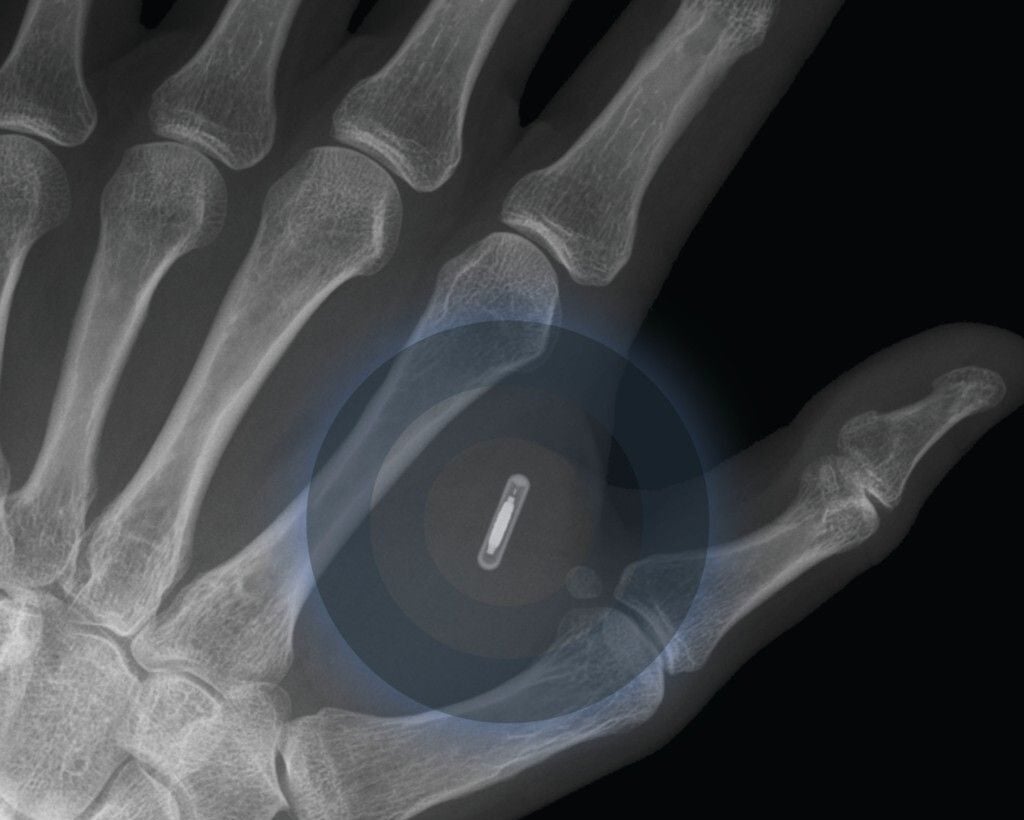
Subdermal microchips have crossed over from concept to clinic, and the technology that engineers them is no bigger than a grain of rice. Swap your wallet, keys and passwords for a single chip that never leaves your body. Frictionless living is exactly that.
But culture always asks the harder question: Convenience, or corporate control?
At The High Crowd, we look for what tech comes next, even when it’s designed to sit right under your skin. Before deciding whether you’d ever give your biology this kind of boost, it’s important to understand exactly what’s at stake.
What Is a Subdermal Microchip, & Why Now?
A subdermal microchip is a passive RFID or NFC device, roughly the size of a grain of rice, implanted just beneath the skin — typically between the thumb and index finger. It stores a unique identifier or personal data and activates only when a compatible reader gets close.
- No battery
- No GPS
- No constant broadcast
Think of it as a contactless bank card that you can never leave at home. The technology is not new, but the cultural moment around it is. Over 6,000 Swedes have already been voluntarily chipped, using their implants to board trains, unlock offices and access health records.
Companies like Biohax International and Walletmor have already made the implant commercially available. According to The Business Research Company, the global microchipping market was valued at $1.85 billion in 2025 — and is still climbing.
Here is what is actually at stake when you ask whether you’d get microchipped, and what it says about where we’re headed.
What Living With a Chip Actually Looks Like
Microchipped users in Sweden report a frictionless daily life. No wallet, no lanyard and no fumbling at the door; the chip works like a contactless card, active only when held close to a reader.
Implantation itself takes seconds; a syringe injection, no stitches, minimal recovery. For a culture that already lives cashless and contactless, the chip is less a revolution than the next logical step.
"The human body is the next big platform. All the wearables we wear today will be implantable."
Hannes Sjöblad | The Swedish Biohacker Network, Bionyfiken Tweet
The Part That Should Make You Pause
The real problem with a chip under your skin is not what it does today, but what it could do tomorrow. Researchers from ScienceDirect call it “function creep.” It’s what happens when technology introduced for convenience quietly becomes a tool for surveillance and social control before the law can catch up.
Here is where the concern gets concrete. Employers who issue chips technically own them. That chip, reprogrammable while still inside your body, could be updated to track your location before and after work hours — without your knowledge.
Brian Green, Director of Technology Ethics at Santa Clara University’s Markkula Centre for Applied Ethics, has a stark warning. With multiple private actors chipping people, governments could become centralised surveillance bodies with access to data flows you never agreed to share. The UK’s Trades Union Congress and the Confederation of British Industry have both raised formal objections.
This is not a fringe conversation. Here is what is actually at stake when you ask whether you’d get microchipped, and what it says about where we’re headed:
- A 2020 study by the American Society for Surgery of the Hand found RFID implants may cause adverse tissue reactions and MRI imaging complications.
- Chips can be hacked and cloned, enabling identity theft through the same vulnerabilities that affect contactless cards. Unlike your bank card, you cannot replace this one.
- Over 13 US states have enacted preemptive bans on mandatory workplace microchipping because regulators already recognise where the technology could go.
Convenience vs. Control: The Honest Comparison
Here is what both sides look like, unfiltered: <view in horizontal mode on mobile>
Factor
Convenience Case
Control Risk
Access & ID
No keys, cards or passwords needed.
An employer or the state could track you 24/7.
Payments
Tap-to-pay from your hand, permanently.
Bank data embedded in your body.
Health data
Emergency responders get your records instantly.
Who owns your health info?
Tech failure
Chip stays put with no battery or app required.
MRI incompatibility, with possible tissue reactions.
Legal status
Voluntary in most countries.
Over 13 US states have already banned mandatory chipping.
Removal
Reversible via a minor procedure.
You alone can not remotely deactivate.
Would you get chipped? Share your thoughts on our Instagram and X pages. Join the crowd on Facebook and exchange elevated perspectives.
FAQs About Human Microchip Implants
The questions people are actually asking, and the straight answers they deserve.
What can a microchip implant actually do for you day-to-day?
The chip functions as a single point of access for multiple daily tasks, requiring:
- No cards
- No phone
- No passwords
Real-world adopters are already using implants to:
- Unlock homes and offices
- Board public transport
- Store emergency medical records
- Complete contactless payments and log into computers.
A 2021 survey found 51% of UK consumers would consider a payment chip implant, with 23% ready to commit given clear medical safety assurances. For anyone who lives cashless and contactless, it is the next logical step.
Why are people & governments pushing back against human microchipping?
Thirteen US states, including California, Wisconsin and Alabama, have already passed preemptive laws banning employers from forcing workers to be chipped. Legislators are recognising where the technology could go.
The core concern isn’t the chip today; it’s what it enables tomorrow. Microbiologist Ben Libberton of Sweden’s Karolinska Institute warns the chip could expose data on your health, location and working patterns without your knowledge.
Additional risks include:
- NFC eavesdropping: Can someone secretly scan the chip in your hand without you knowing?
- Data interception: What stops a third party from capturing your data mid-transfer?
- The legal grey zone: Who actually owns a chip once it’s inside an employee’s body?
Can my employer force me to get a microchip implant?
In most jurisdictions, including over 13 US states that have passed preemptive bans, mandatory workplace microchipping is illegal. In South Africa, compelling an employee to undergo any medical procedure without consent would likely conflict with the Constitution’s right to bodily integrity. Voluntary programmes exist, but coercion is widely considered a violation of employee rights.
Are human microchip implants legal in South Africa?
There is currently no South African law specifically banning or regulating subdermal microchip implants. The practice sits in a legal grey zone, governed loosely by existing privacy legislation (POPIA) and medical device regulations. No employer may compel implantation under general constitutional privacy protections, but dedicated legislation does not yet exist.
How many people had a microchip implanted in 2025?
Globally, more than 50,000 people had voluntarily received subdermal implants by 2025. Sweden leads adoption, with thousands of citizens already chipped for everyday use.
The broader microchipping market was estimated at between $1.85 and $1.99 billion in 2025, with multiple analysts projecting continued growth through 2032. Figures vary across research firms, reflecting an industry still in its early commercial phase.
So, convenience or corporate control?
Apple TV’s Pluribus asks a fictional version of that same question, trading individual autonomy for a happier, more connected collective. Contact us with your opinion. We’re listening. Trust The High Crowd for high-grade human interactions every time.
The High Crowd: Culture Elevated
At The High Crowd, we sit at this crossroads, where technology meets lived experience, and the culture asks real questions rather than waiting for a press release. The biochip debate is not a Silicon Valley story. It’s a story about who controls your body, your data and your daily life in a world moving fast toward frictionless everything.
We don’t chase trends; we track culture where it actually lives, from our Lifestyle Hub to the streets. Whether the crowd gathers around a chip under the skin or a joint passed between friends, the question is always the same: Who benefits, and who needs to know?
Cannabis normalisation taught us that the fight for personal choice is never just about the substance. South Africa’s private-use cannabis law has already proved that the same autonomy fight can be won, one legal grey zone at a time.
Visit our THC420 page to see how that fight continues. It is about autonomy. The biochip debate is the same fight, wearing a different skin. Culture elevated, and always, relentlessly real.